
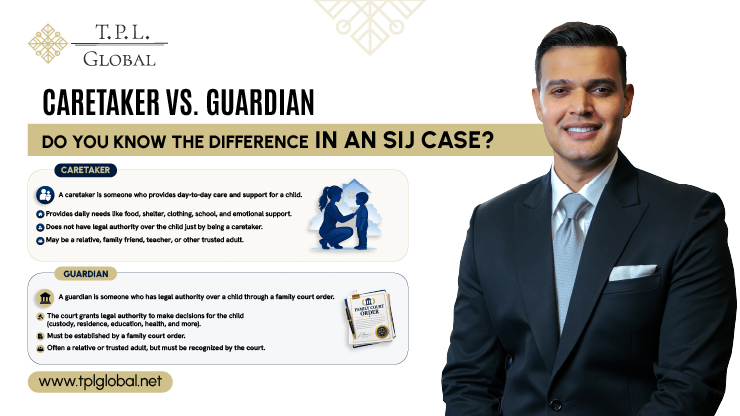
Caretaker vs. Guardian: Do You Know the Difference in an SIJ Case?
Caretaker vs guardian in an SIJ case is one of the most important distinctions a family can understand before pursuing Special Immigrant Juvenile (SIJ) status — because the two roles are not legally the same, and mixing them up can slow down or even derail a child’s case. At TPL Global, we regularly guide families through exactly this question so the right legal steps are taken from the start.
What Is a Caretaker?
A caretaker is someone who provides day-to-day care and support for a child. This typically includes:
- Providing daily needs like food, shelter, clothing, school, and emotional support
- Being a relative, family friend, teacher, or other trusted adult
Importantly, a caretaker does not have legal authority over the child just by being a caretaker. Caring for a child day to day — even for years — does not, on its own, create a legal relationship that U.S. immigration law recognizes.
What Is a Guardian?
A guardian is someone who has legal authority over a child through a family court order. This means:
- The court grants legal authority to make decisions for the child — custody, residence, education, health, and more
- Guardianship must be established by a family court order
- A guardian is often a relative or trusted adult, but must be formally recognized by the court
That court order is what separates a guardian from a caretaker in the eyes of the law.
Caretaker vs Guardian in an SIJ Case: Why the Difference Matters
The family court order — whether it grants guardianship, custody, or a similar arrangement — is what makes the legal difference in a Special Immigrant Juvenile Status case. It’s part of what establishes the legal findings USCIS needs to see: that reunification with one or both parents isn’t viable due to abuse, neglect, abandonment, or a similar basis under state law, and that it isn’t in the child’s best interest to return to their home country.
Without a court order, informal caregiving — however loving and consistent — generally cannot support an SIJ petition on its own. USCIS looks for the legal authority and findings that only a family court can provide.
If You’re Caring for a Child but Don’t Have a Court Order Yet
If you are currently caring for a child but don’t yet have legal guardianship or custody, that is often the first conversation to have — both with a family law attorney and with an immigration attorney who understands how SIJ cases work. Getting the court order in place early can save significant time later in the immigration process.
How the SIJ Process Generally Works
- A state family court issues an order addressing custody/guardianship and the required findings (non-viability of reunification and best interests)
- The qualifying child or their representative files Form I-360 with USCIS, along with the court order and supporting evidence
- Once SIJ status is approved, the child may become eligible to apply for lawful permanent residence (a green card)
For the full federal regulation defining special immigrant juvenile classification, see 8 CFR 204.11 in the Electronic Code of Federal Regulations.
Have Questions About a Child in Your Care?
Every family’s situation is different, and whether you currently hold caretaker or guardian status can change what your next legal step should be. The team at TPL Global can help you understand where you stand and what’s needed to move a child’s case forward. Book a consultation to talk through your situation.
FAQs: Caretaker vs Guardian in an SIJ Case
Can a caretaker file for SIJ status without a court order?
Generally, no. SIJ status requires specific findings from a state family court, which a caretaker role alone does not provide. A guardianship, custody, or similar court order is typically necessary.
How do I become a legal guardian instead of just a caretaker?
You would need to petition the family court in your state for guardianship or custody. Requirements vary by state, so speaking with a family law attorney is an important first step.
What findings does USCIS need to see in an SIJ case?
USCIS requires a state court determination that reunification with one or both parents isn’t viable due to abuse, neglect, abandonment, or a similar basis, and that returning to the child’s home country isn’t in their best interest. Details are outlined in USCIS’s SIJ eligibility guidance.
Does being a relative automatically make me a guardian?
No. Being a relative may make you a likely candidate for guardianship, but legal guardian status still requires formal recognition by a family court.
How can TPL Global help with an SIJ case?
We help families understand the caretaker vs guardian distinction, coordinate with family court proceedings, and file the SIJ petition with USCIS. Contact TPL Global to get started.